Plumbing Best Practices
This guide covers how to mount your machine and connect the plumbing.
Important: Do not power on the machine yet. This guide is only for physical installation.
1. Mounting the Machine
Section titled “1. Mounting the Machine”Choose a location that is stable, level, and easy to access.
- Secure it: Bolt the machine down according to the manufacturer's guidelines so it cannot tip or move while driving.
- Protect it: Try to place the machine where it is protected from extreme weather or physical damage.
2. General Plumbing Requirements
Section titled “2. General Plumbing Requirements”These standards apply across every layout in this guide.
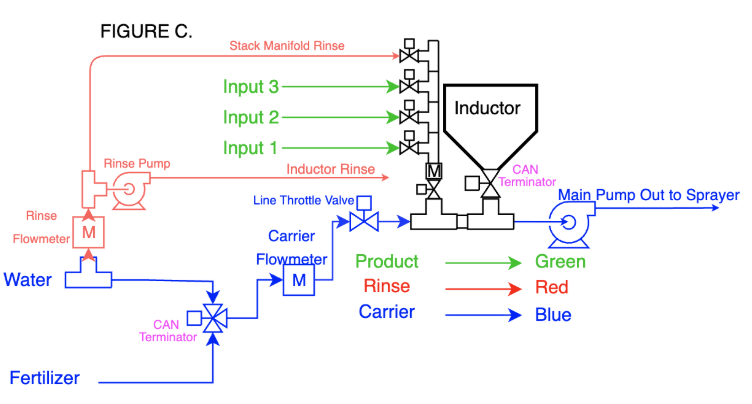
Color Codes — we use these colors in our diagrams to make things clear:
- Green: Product lines (Chemicals)
- Red: Rinse lines (Clean water for cleaning)
- Blue: Carrier lines (The main water source)
Hose Sizing — for the best performance, use product hoses that are 1.25 to 1.5 inches (32 to 38 mm) in diameter. This size offers the best balance: it allows for fast flow rates but keeps the amount of chemical trapped in the hose to a minimum. Smaller hoses will slow down your mixing.
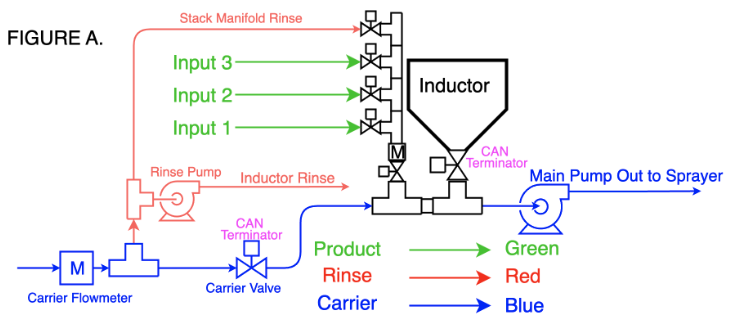
Rinse Line Routing — the rinse line connects between the main carrier meter and the carrier valve. The pressurized side goes directly to the Mixmate Inductor to clean jugs; the non-pressurized side supplies the stack manifold.
Rinse Pump Requirements — if you are using a pump to pressurize the inductor, it must be strong enough to clean the jugs properly. It needs to deliver:
- Flow: At least 25 Gallons Per Minute (95 Liters Per Minute).
- Pressure: It must maintain 25 PSI (1.7 bar) while flowing at that rate — typically requiring at least 2 horsepower (1.5 kW).
- Note: Maximum pressure for components is 100 PSI (6.9 bar).
3. Plumbing Layouts
Section titled “3. Plumbing Layouts”There are several ways to plumb the machine depending on how many water sources (Carrier Inputs) you have. Pick the layout below that matches your setup.
One 2-Way Valve — Single Carrier Input (Most Common)
Section titled “One 2-Way Valve — Single Carrier Input (Most Common)”This is the most common setup. It uses a single 2-way valve to control one main water source.
Component order is critical for the system to function correctly:
- Carrier Flowmeter: Measures the water coming in.
- Rinse Line Tee: Splits off water for cleaning after the meter but before the valve.
- Carrier Valve: Controls the flow to the rest of the system.
- Mixmate Components: The inductors and manifolds where chemicals are added.
- Main Pump: Pulls everything through the system.
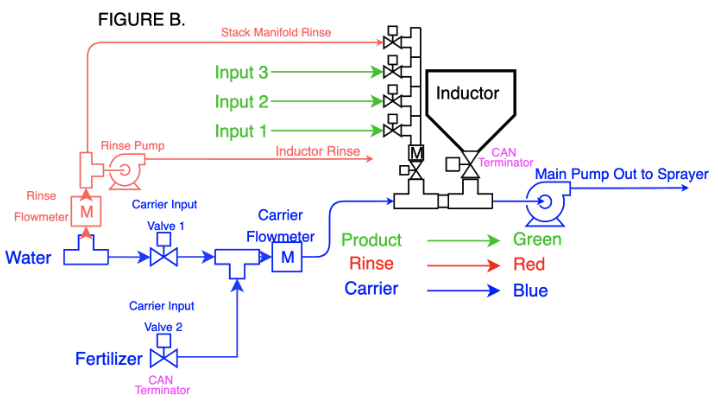
Multiple Inputs with 2-Way Valves
Section titled “Multiple Inputs with 2-Way Valves”This setup uses multiple 2-way valves joined together by a manifold to switch between different water sources. The manifold combines the flow before it passes through the main flowmeter.
The valves must combine into the manifold before the liquid reaches the flowmeter so that all sources are measured correctly.
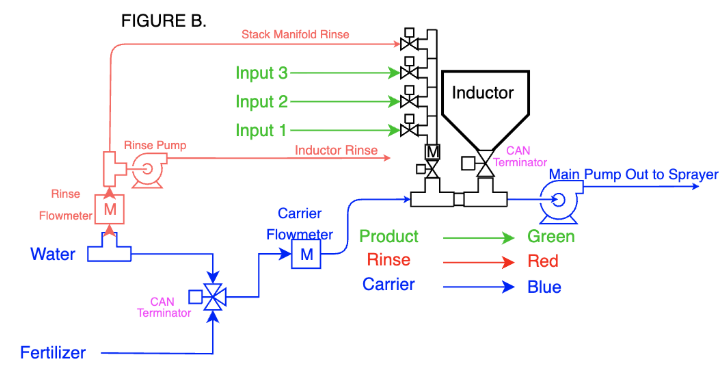
Multiple Inputs Using a 3-Way Valve
Section titled “Multiple Inputs Using a 3-Way Valve”This setup uses a single 3-way valve to switch between two carrier sources, typically water and fertilizer.
Important: In this layout, the water line splits before the 3-way valve to provide a source for rinsing. Because this rinse water bypasses the main valve, it needs its own flowmeter to ensure it is measured correctly — place the rinse line tee so you always have clean water available for rinsing, even if the main valve is set to fertilizer.
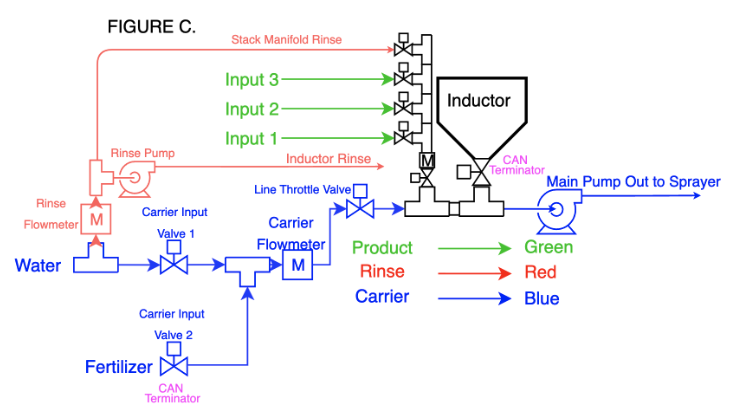
Multiple Inputs with a Line Throttle and 2-Way Valves
Section titled “Multiple Inputs with a Line Throttle and 2-Way Valves”This setup uses multiple 2-way valves joined by a manifold to switch between different water sources, plus a Line Throttle to control the flow speed.
Why use a Line Throttle?
- Distance: It allows you to place your shutoff valves further away from the Mixmate system while still maintaining full control over the speed of the water.
- Mass Flowmeters: If your system uses a mass flowmeter, a line throttle is often required to make it work properly.
The throttle must be placed correctly in the component order to control the flow effectively.
Multiple Inputs with a Line Throttle and 3-Way Valves
Section titled “Multiple Inputs with a Line Throttle and 3-Way Valves”This setup uses 3-way valves to switch between different water sources (like fresh water vs. fertilizer) and adds a Line Throttle to control the flow speed.
Same advantages as above (distance and mass flowmeter support) — the throttle must be placed correctly to control flow after the valves.
4. Final Check
Section titled “4. Final Check”Before you move on, do a quick inspection:
- Is the machine securely mounted?
- Are all liquid lines connected and tight?
- Are there any visible leaks?
- Is the machine still powered OFF?